Get in Touch
Email Address
hello@creativitek.com
Phone Number
+61 423 493 386

hello@creativitek.com
+61 423 493 386

The client: Australian Government, Department of Social Services
Consortium partner: Australian Federation of Disability Organisations (AFDO)
Funding: The Information, Linkages, and Capacity Building (ILC) program; Individual Capacity Building grants
Problem/Gap
The increasing dependence on online engagement, including the digitisation of many government services, has contributed to a widening digital divide. Individuals with disabilities, especially those in rural and remote areas, are encountering increased disadvantages due to limited digital skills and knowledge. Additionally, many people with disabilities (PwD) are not familiar with the most current work-related rights and legal processes. Peer role modelling and social stories are pivotal in building capacity of PwD. This project targets the following specific gaps: (1) Social Stories: AR social stories, despite their educational potential, remain underutilised globally. Australia is a multicultural society yet social stories are primarily available in English, limiting accessibility for CALD groups. There's an absence of social stories for Australians with intellectual and learning disabilities that build skills for engaging with government services, work-related rights and legal processes. (2) Peer Role Modelling: Building skills of PwD could be greatly enhanced by peer role model stories presented through immersive technologies like AR - if you can’t see it you can’t be it.
Goals
- Collaboratively identify target behaviours and situations for augmented reality social stories
- Co-design and develop 16 AR social stories and 10 AR peer success stories to enhance individual capacities among people with disabilities
- Co-design and implement a marketing strategy to raise awareness of the project and maximise its usage and impact
- Co-evaluate the results and impact of the project using quantitative and qualitative data
Solution
The project will co-design and co-develop 16 AR social stories in 4 community languages. Tailored for individuals with intellectual and learning disabilities and those from CALD backgrounds the stories will cover disability rights, self-advocacy, work-related rights and government services. Ten augmented reality peer success stories will also be developed, focusing on real-life success stories modelling independence and skill development in individuals with diverse disabilities. Using 3D animation, audio and text the project will work with PwD to create engaging interactive stories. An AR app will give access to both social stories and peer role modelling stories. Resources will be also available on AFDO's website with downloadable/printable one-page stories; each page helping the audience use the AR app to animate stories directly on the page using smart phones or tablets. A comprehensive marketing strategy across the disability sector and mainstream media as well as social media, direct email, webinars and conference presentations will be implemented to create awareness of the project and its applications. Online webinars and in-person workshops will be organised for the target audience to meet the peer role models and pose their questions. An augmented reality-enhanced brochure will also be published and distributed to AFDO's 38 member organisations, National Disability Services (NDS), and other entities that can assist us in reaching a broader audience of people with disabilities and expanding the project's reach and impact. The anticipated outcomes encompass an improved understanding of current government services, work-related rights, and typical legal processes, along with increased confidence in interacting with individuals and procedures within those domains.
Solution
This is a three-year project, running through to 2027. Together with people with disability, we are co-designing and co-developing 16 AR social stories in four community languages. Tailored for people with disability and those from CALD backgrounds, the stories cover disability rights, self-advocacy, work-related rights and government services. Each social story uses AR animations to guide the audience step by step through a real-life situation, such as learning about the NDIS, preparing for an NDIS planning meeting, finding service providers or travelling independently.
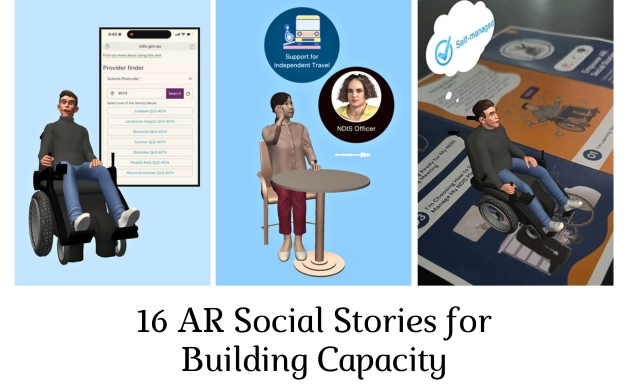
Ten augmented reality lived experience stories are also being developed, giving audiences the chance to see how other people with disability experience the world, manage their challenges, and both fail and achieve their goals. Each story has been designed in collaboration with its role model, and every detail, from the 3D elements and environments to the voices, has been chosen to reflect that person's own story. The result is a set of stories built on shared learning and growth.
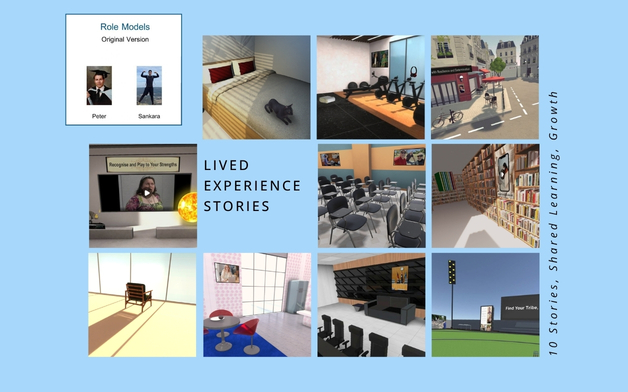
Using 3D animation, audio and text, the project works with PwD to create engaging, interactive stories that people can watch, listen to and learn from at their own pace.
An AR app gives access to both the social stories and the peer role modelling stories. Resources are also available on AFDO's website with downloadable, printable one-page stories, each page helping the audience use the AR app to animate stories directly on the page using smartphones or tablets.
A comprehensive marketing strategy across the disability sector and mainstream media, as well as social media, direct email, webinars and conference presentations, is being implemented to create awareness of the project and its applications. Online webinars and in-person workshops are being organised for the target audience to meet the peer role models and pose their questions.
We have also designed four accessible, AR-powered brochures: two featuring role models and two presenting social stories. The brochures come to life with the EmpowerAR app, so readers can scan any picture and watch its story in their choice of four languages. They have been published and distributed to AFDO's 38 member organisations, National Disability Services (NDS), and other entities that can help reach a broader audience of people with disability and expand the project's reach and impact.
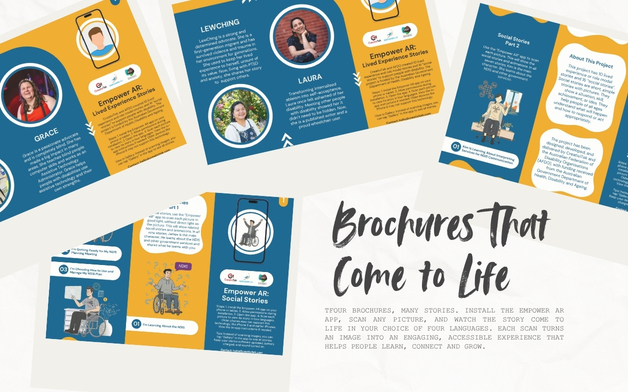
The anticipated outcomes encompass an improved understanding of current government services, work-related rights, and typical legal processes, along with increased confidence in interacting with individuals and procedures within those domains.
Although virtual reality wasn't part of the original solution for this project, Katie's story was such an amazing one that we decided to bring it to life in a virtual reality experience as well, for promotional purposes and to showcase the capability of both AR and VR in storytelling, and what each of these technologies can offer.
Try the Experience Yourself
The EmpowerAR app was developed as part of the project and published in August 2026. It is now available free on both the App Store and Google Play Store for our target audience to use. Inside the app, users can choose their language, browse the role model and social stories, explore the AR experiences, and pick from Easy Read, text-only, audio-only and video instructions.
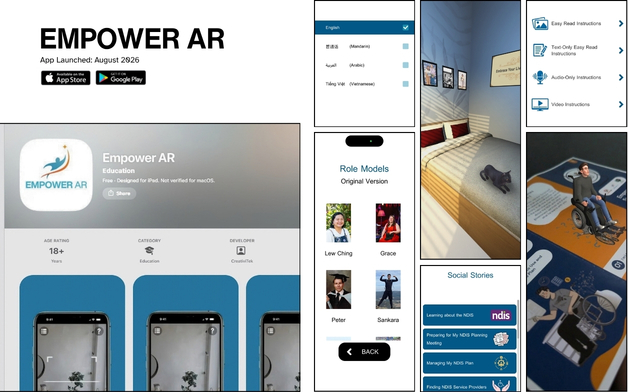
The project's brochures are also ready to download and print.
Scan the images on the brochures using the EmpowerAR app to bring the stories to life. Make sure you allow the permissions the app requests when you install it, keep your mobile device up to date, and turn your sound on so you can hear the animations. If you don't have a printed brochure handy, you can also go straight to the Gallery section within the app to find all the stories.
The app is available in four languages: English, Arabic, Mandarin and Vietnamese. It also includes accessibility features such as screen reader support and accessible versions of the lived experience stories for those with vision impairment.
If you need any support, email This email address is being protected from spambots. You need JavaScript enabled to view it..
Outcomes
As of September 2026, the project has already delivered strong outcomes for the people involved and the wider disability community:
Further results will be reported on project completion in 2027.