Get in Touch
Email Address
hello@creativitek.com
Phone Number
+61 423 493 386

hello@creativitek.com
+61 423 493 386
By Dr Naser Zamani
Updated: 29 June 2026
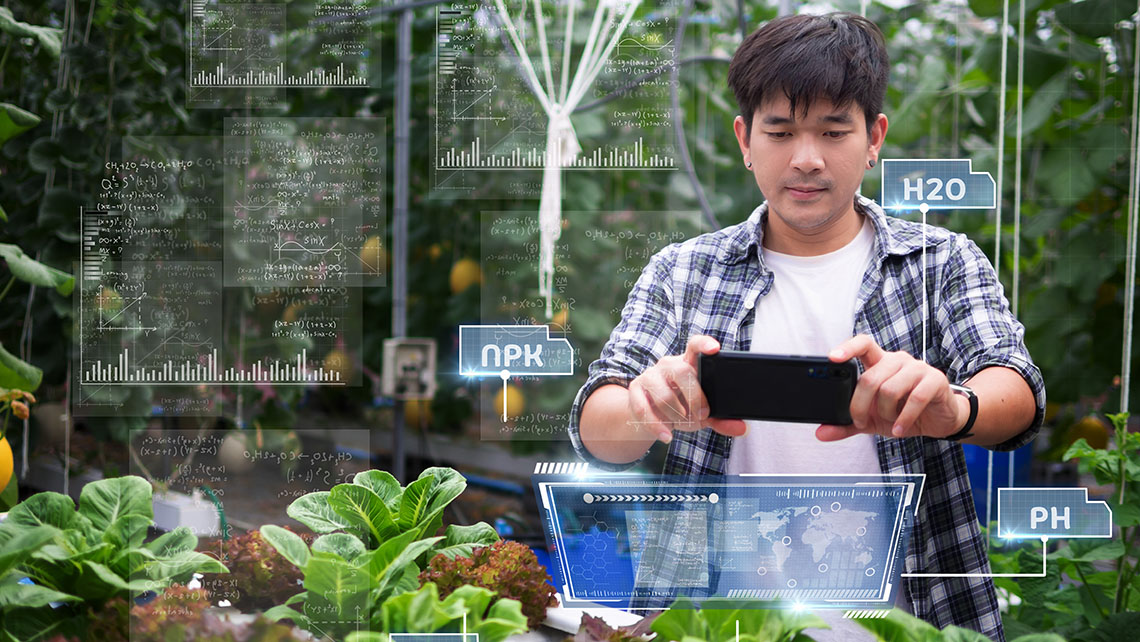
Augmented Reality (AR) offers diverse opportunities for agricultural extension, education, and rural development by seamlessly blending virtual content with the real world. This integration can occur through mobile phones and head-mounted displays or smart glasses, enhancing the physical environment with valuable digital information. Differentiating from Virtual Reality (VR), which immerses users in a completely virtual world, AR improves the real world. Mixed Reality (MR) is when virtual and real environments mix and interact with each other. The term Extended Reality (XR) serves as an umbrella encompassing AR, VR, and MR.
At their core, AR and VR are doing two things at once: they are creating new types of content, such as 3D models, immersive 360° footage, branching scenarios, and shared virtual spaces, that simply did not exist in print or video form before, and they are enabling new extension methods, ways of teaching, demonstrating and collaborating that were not previously practical at scale, such as letting a trainee fail safely inside a tractor rollover scenario, letting a remote expert annotate a farmer's real field of view in real time, or taking a researcher virtually onto a real paddock they may never have visited in person, to observe a trial, a soil profile, or a pest outbreak as if standing in it themselves. Used well, immersive technology can support agricultural extension, education and rural development across the full spectrum of what that work actually involves, well beyond the farm gate: raising awareness and sharing information with farmers and the wider rural community, engaging audiences who would otherwise tune out a print leaflet or a lecture, building capacity through rehearsal of real skills and decisions, collaboration between farmers, researchers, extension agents, knowledge brokers and rural communities who are not in the same place, and, done well with the community as co-designer rather than only as audience, genuine empowerment. This last point matters particularly for rural development. The same technology that delivers a 360° or VR experience to a farmer can, if designed with the community rather than only for it, become a tool the community uses to preserve local knowledge, plan its own infrastructure, or represent its own priorities to researchers and policymakers.
The adoption of AR and VR in agricultural extension, education and rural development brings numerous advantages, including heightened interactivity, increased engagement, improved access to experts through remote collaboration, digital enrichment with reduced reliance on print materials, elevated excitement through gamification, multi-sensory and immersive experiences, mobile accessibility, and compatibility with IoT, 5G, AI, and digital twins for smart farms. It is worth highlighting one advantage in particular, because it is easy to overlook: these technologies generate new kinds of evaluation data for extension and education. Gaze, dwell time, the path someone takes through a decision scenario, even heart rate during a safety simulation, can all be captured automatically during an XR session, data that no print material, video, or in-person demonstration has ever been able to offer extension providers for monitoring and evaluation purposes.
The methods and examples below were initially presented in part as augmented reality extension tools and methods by the author at the 2023 Australasia-Pacific Extension Network (APEN) International Conference, held in Launceston, Australia. This blog was first published shortly after the conference. The author then presented at the APEN conference held in Brisbane in 2025, titled "Using Mobile Augmented Reality for Capacity Building, Community Engagement, and Empowerment: Insights from Practice," to share some of the author's recent projects and advances in the XR industry. This blog was later updated in June 2026 to expand its coverage of VR and the most recent developments in immersive devices, illustrated throughout with examples from agriculture, rural development, environmental education and rural community engagement from around the world.
Augmented Reality (AR) Tools and Methods
AR-enabled print materials: Traditional print materials are enhanced with AR features, making them interactive communication channels. For instance, an agricultural magazine could come alive when a farmer scans an image in it using their mobile phone, showing videos of farming techniques, interviews with experts, or interactive 3D models of innovative agricultural machinery. The same approach extends naturally to product packaging: scanning a seedpacket, a fertiliser bag, or a product bottle’s label or logo can trigger usage instructions, safety guidance, or a brand story directly on a consumer’s or farmer’s phone, turning the product itself into the trigger for the AR experience rather than a separate leaflet.
To learn more about a case study where we used AR to assist Yakult's audience in activating an educational poster using their mobile phones and learning how Yakult improves gut health, click HERE.
AR storytelling: AR storytelling takes storytelling to the next level. In agriculture, AR storytelling can immerse users in a crop's lifecycle, illustrating growth stages and best practices. Users can interact with virtual representations of pests or diseases, enhancing their understanding. Click HERE to view a YouTube video of a mobile AR storytelling experience we created for a project to build capacity among people with disability, using peer stories and social stories. After an AR experience, mobile users see themselves in a virtual 360-degree gym where there are lots of interactive images, videos and objects to interact with and explore in the story.
Social Media AR Ads: Integrating AR camera effects into mobile ads on platforms like Snapchat and TikTok enhances campaign performance. From 360° personalised farm visits to gamified learning experiences, social media AR ads create interactive and engaging content for awareness and education purposes, particularly among younger farmers and rural youth, who are the main users of such social media platforms. Click HERE to read about our award-winning government-funded project, where we utilised social media AR ads to engage parents and educate children about road safety using gamified learning experiences.
AR-assisted demonstrations: AR helps organise virtual farm demonstrations or improve traditional in-person Method Demonstration and Result Demonstration. These methods are based on the fact that farmers like to see how a new idea works and also what effect it can have on increasing their crop production, and AR adds extra layers of information on the physical real world and allows users to see things in an immersive and unique way. Click HERE to explore a case study where we utilised AR to illustrate the traditional method of gold mining in the West Wyalong region.
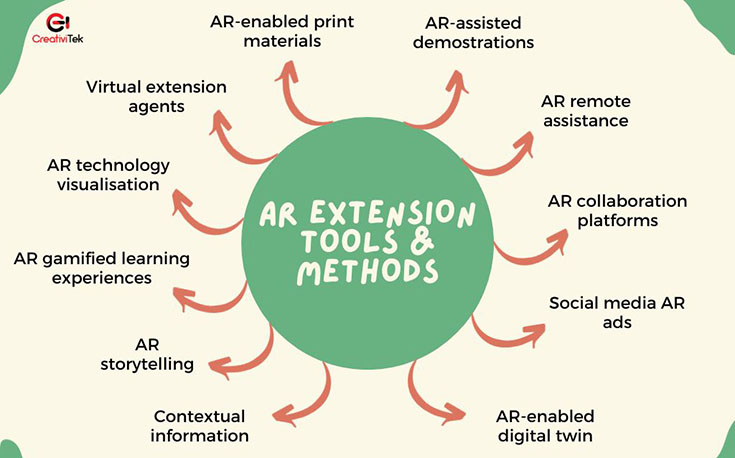
Virtual extension agents: Virtual extension agents, whether human-like avatars or computer-generated, offer personalised advice on crop management, pest control, and irrigation. A farmer can typically ask a question by voice or text, point their camera at a crop or symptom, and receive a response drawing on agricultural data and expert knowledge, similar to a phone call with an adviser but available at any hour and in multiple languages. Equipped with AI tools, they provide sophisticated solutions where individual expertise falls short, enhancing accessibility to expert guidance, particularly useful where extension staff are stretched thin across large rural areas, or at remote demonstration farms where extension agents are not always available on site and farmers can visit and hear from a virtual extension agent in person.
Contextual information: AR provides real-time contextual information, aiding farmers in making informed decisions. An AR app can overlay weather forecasts, soil conditions, and crop-specific data when pointed at a field, facilitating better decision-making regarding irrigation, harvesting, and pest control.
AR remote assistance: AR remote assistance offers real-time guidance without the expert needing to be physically present. Farmers facing crop issues can share live video feeds with agricultural experts, who provide virtual annotations and instructions directly onto what the farmer is looking at, circling a diseased leaf or marking where a part needs adjusting, facilitating remote troubleshooting and support that would otherwise require a farm visit and the delay that comes with it.
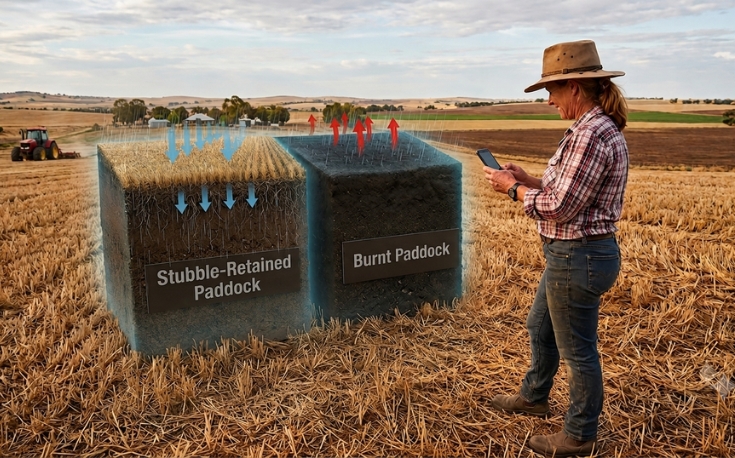
AR technology visualisation and best practice demonstration: AR visualises both complex agricultural technologies and best practice techniques that are otherwise difficult to see or explain. For machinery, this can mean showing the internal workings of a seed drill or the flow of a hydraulic system as an overlay on the real machine, parts that would otherwise be hidden inside a housing, useful both for training new operators and for diagnosing a fault before calling a technician.
For best practice, take stubble retention in cropping. Leaving stubble on a paddock after harvest, rather than burning it, helps reduce wind erosion and can improve how much water the soil holds onto, but the benefit depends on rainfall and can take a full season or more to show up, which is part of why many growers still consider burning when stubble loads get heavy. With AR, a farmer could stand in their own paddock and see an overlay comparing a stubble-retained paddock against a burnt one side by side, showing water moving into the soil and being lost to evaporation over time, making a slow, often invisible benefit something they can actually see, and giving them a clearer reason to stick with the practice rather than reverting to burning. The same challenge shows up in conservation programmes promoting no-till farming and cover cropping more broadly, where the effect on the soil's water-holding capacity is similarly real but slow to appear and hard to see season to season.
AR collaboration platforms or experiences: AR collaboration platforms and experiences enable stakeholders to interact with 3D models and virtual content as if they were standing around the same table. Agricultural researchers, extension agents, and farmers across different locations can collaborate, discuss scenarios, and enhance overall efficiency and interactivity, for example jointly reviewing a 3D model of a proposed irrigation layout and marking changes directly onto it, rather than relying on a phone call and a written report.
AR gamified learning experiences: AR gamified learning experiences engage and educate farmers by turning a learning task into something closer to a game. Educational apps gamify learning about sustainable farming practices, allowing users to interact with virtual challenges, such as correctly identifying a pest before it spreads across a virtual field, earn rewards, and apply acquired knowledge to improve their virtual farms, reinforcing the lesson through repetition without it feeling like repetition.
AR-enabled digital twins: AR digital twins offer a virtual representation augmented with real-time data. In agriculture, they can be created for crops, machinery, or entire fields, providing a dynamic and interactive mirror for awareness and education, monitoring, analysis, and other purposes. For instance, AR digital twins can be utilised to simulate smart farms, enabling farmers to understand the integration of Internet of Things (IoT) devices and their contributions to agriculture.
Virtual Reality (VR) Tools and Methods
360° VR Videos/Experiences: 360° VR is one of the most widely used entry points into immersive technology for agricultural extension and education around the world, largely because it is low-cost and accessible, while still being engaging enough to capture audience attention and support strong learning outcomes when used well. Footage is captured with affordable, readily available 360° cameras and brought together with some post-production work, rather than requiring specialist 3D-modelling skills. A 360° video or still-image "virtual tour" lets the viewer look freely around a real, filmed scene, giving a genuine sense of being there that a standard 2D video cannot offer. Whether this counts as genuine VR is contested. It satisfies the head-tracked, presence-generating criteria many researchers use to define VR, but because it is a fixed recording rather than a responsive environment, others reserve "VR" only for fully computer-generated content.
In practice, once narration, interactive hotspots (clickable or gaze-triggered points that can launch a video, image, or linked scene), data overlays or branching menus are layered on top, a 360° capture becomes a rich, genuinely immersive multimedia experience that works across headsets, mobile phones and desktops alike.
Click HERE on your desktop or mobile phone to try a sample 360° experience with hotspots to interact with and explore more of a dairy farm. A strong example at scale is a VR training programme by GIZ and the International Cotton Advisory Committee for sustainable cotton cultivation in Cameroon and Burkina Faso, immersing farmers in a realistic virtual cotton field to observe soil, pests and beneficial insects up close. Now expanded to five further countries, it has trained 285 farmers and trainers and influenced over 20,000 cotton farmers, reaching rural learners regardless of literacy. Click HERE to watch a video report on the project.
VR Storytelling: VR storytelling places the learner inside a narrative rather than simply showing them a recorded place, helping them process and remember what they experience rather than just observing it passively. Like 360° experiences, a VR story can include interactive elements such as images, video clips and decision points, deepening the learning experience further. In agriculture, this can mean walking a learner through a crop's lifecycle, or experiencing a season of pest pressure or drought unfold as a story with consequences, typically more memorable than the same facts as a list.
This same approach works well applied to farmers themselves, for example, a VR story following a farmer who managed their property through a long drought, sharing the decisions and resilience involved so other farmers facing similar conditions can learn from lived experience. We have used this storytelling approach in our own work to build capacity among people with disability. Click HERE to watch a VR storytelling experience telling the story of Katie Kelly, Australian gold medallist, created by CreativiTek and AFDO.
The Rural Minds Project, launched in the UK in 2025 by three rural doctors and Revolve Labs, uses immersive 360° footage to place the viewer in the boots of a farmer facing isolation, financial strain and generational pressure. It was built to address the mental health and suicide-risk crisis in farming, and to build empathy among GPs and policymakers. It is freely available through a VR headset, mobile phone, or desktop browser. Click HERE to try the experience on your desktop.
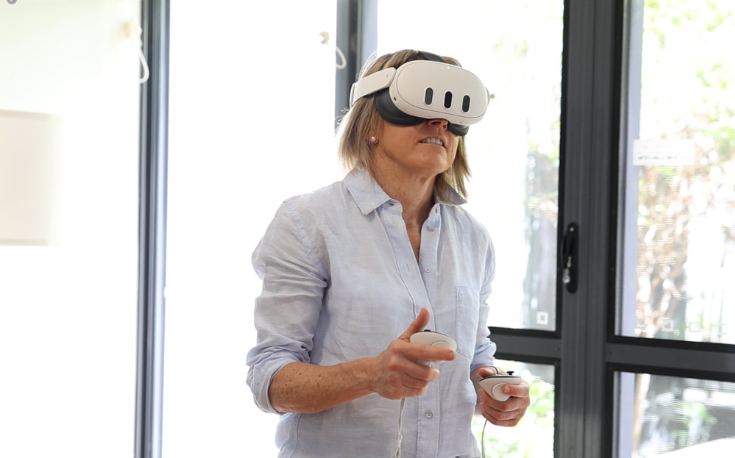
Interactive VR Simulations: Interactive simulations give the learner real agency: they act, and the environment responds. VR simulation mimics crop development, livestock rearing and supply chain processes inside a precisely controlled, interactive environment, letting farmers build technical skills and rehearse complex tasks, from machinery operation to animal handling, without the risk of hands on testing on a live farm. Farming Simulator VR, developed by GIANTS Software and released for Meta Quest in February 2025, shows how realistic and accessible this has become, letting players sow and harvest crops, maintain real farming machines in a repair workshop, and operate authentic tractors from inside the cab. Click HERE to watch a YouTube video of the experience.
Scenario-Based Decision-Support Activities: The most decision-oriented VR method presents the learner with a defined scenario, a specific irrigation plan, a pest outbreak, a drainage layout, a herd health problem, a tractor rollover, and asks them to choose a course of action, then shows the consequence. This differs from open ended simulation in that the scenario is structured around a decision point, closer to a branching case study than a sandbox. Some of these experiences now include an AI enabled extension agent built into the scenario itself, observing the choices a learner makes and offering tailored feedback or follow up questions in the moment, rather than only a fixed, pre-scripted outcome. CropLife International's VR training programmes use this kind of branching approach to walk farmers and farm workers through pesticide safety decisions step by step, with each choice tracked and checked.
Collaborative / Multi-User VR Activities: Unlike the methods above, which are built around a single learner, collaborative VR is defined by co-presence: multiple people occupying the same virtual space at the same time, able to see, talk to, and act on the same objects together. For agricultural extension and rural development, this opens up activities the other categories cannot deliver on their own. Extension agents, agronomists and farmers in different locations can stand around the same 3D model of a piece of machinery to work out together how it should be maintained or repaired, rather than relying on a phone call and a written manual. Researchers, vets, soil scientists and farmers can be brought into one shared environment to work through a complex problem in real time, each contributing their own expertise to a single shared model. An AI enabled extension agent can sit inside these sessions too, answering questions on the spot, pulling up relevant data, or summarising the discussion for someone who joins partway through, working alongside the human participants rather than replacing them. This is also the strongest setting for participatory, community-led design, where a farming or rural community is brought into the development process to help shape the content itself, rather than only receiving it once finished.
3D VR Models and Animations: A real farm is never flat: soil has depth, insects move, machinery has moving parts, and crops change shape as they grow, none of which a 2D photo or video fully captures. With VR technology, the object or process can be rebuilt as a 3D form that can be rotated, zoomed into, and often animated, a soil profile sliced open, an insect examined from every angle, or a beneficial insect shown consuming a pest over time. Interactive versions let a learner tap a part of a machine to see how it moves or be walked through a repair step.
Imagine using VR to show how Trichogramma wasps actually work. These are tiny parasitic wasps, smaller than a pinhead, used as a biological control for Helicoverpa, the cotton bollworm. Farmers can interact with them directly, rotating and resizing the model, listening to narration, and asking questions, whether answered by an AI enabled assistant or through pre-prepared responses built into the experience. The female wasp deposits her egg inside the pest's egg, and the wasp larva hatches and develops inside the host egg, consuming its contents, destroying the pest before it ever hatches into a crop damaging caterpillar. As this happens, the host egg gradually darkens, a visible sign of parasitisation that would otherwise be impossible to observe at natural scale.
The video below shows a farmer examining a Trichogramma wasp and egg in 3D using a VR headset, rotating, resizing and exploring the model up close using hand tracking gestures, revealing details no naked eye could otherwise make out in the real world. Watching the wasp deposit her egg, the host egg darken, and a newly born wasp emerge and fly off is a far more memorable and engaging way to learn about this process than a flat photo or diagram, and is the kind of experience that could meaningfully increase farmer understanding and uptake of biological pest control. Research shows spatial memory and learning outcomes improve when content is presented in 3D rather than 2D, particularly for accurate field recognition and understanding biological processes. An AI enabled extension agent can sit alongside an experience like this, answering questions in real time, much like an expert standing beside the learner.
Current Advances and New Opportunities
1. Growing realism and immersion: Footage, models and overlays increasingly look and move like the real world they represent, rather than the flatter, more game-like look earlier headsets and apps were known for, which matters directly for extension, since the whole point of these tools is to show something as it actually is.
2. Stronger mobile phones: Current smartphones now have enough processing power and camera quality to capture and render 3D content and convincing AR experiences directly, without specialist equipment, so tools that once needed a dedicated production studio are now in the hands of an ordinary extension officer or a farmer filming their own field. This same capability supports AR experiences triggered by scanning a product pack, a bottle, or a brand logo, letting a seed packet or a piece of produce come alive with usage guidance or a brand story the moment it is scanned.
3. Growing access to high speed internet, including in remote areas: Internet speeds have continued to improve broadly, and access to high speed connectivity in rural and remote regions is expanding as well, narrowing a gap that has historically limited live, data heavy experiences in farming communities furthest from major centres. This matters directly for the AR collaboration and AR remote assistance methods described earlier, since both depend on a stable connection to work well.
4. Cheaper, higher quality VR headsets, now with AR and MR built in: Headsets have continued to fall in price while improving resolution, comfort and field of view. The latest generation also increasingly blends VR with AR and MR capability in the same device, using passthrough cameras that let a wearer see and interact with their real surroundings without removing the headset, switching instantly between a fully virtual scenario and a real-world overlay. This makes interactive simulation, scenario-based decision support, collaborative VR, and the kind of real-object-anchored MR experiences described earlier all realistic to deliver from a single device. An extension office, a farmer training programme or a rural community group can now own one headset rather than needing separate VR and MR hardware.
5. Adapting content across devices: A 360° tour, a 3D model or an interactive scenario can increasingly be adapted for a basic smartphone, a desktop browser, a VR headset and AR glasses from a shared underlying build, rather than being produced separately from scratch for each platform. This still requires deliberate design and adaptation work for each device, but it reduces duplication of effort and allows extension content to be matched to whichever device an audience already has.
6. AI and AR smart eyeglasses: The device landscape now spans roughly three tiers, though the lines between them are still shifting as new products launch. One tier is AI-only glasses with voice and camera but no display, such as Meta's Ray-Ban line, useful as a hands-free virtual extension agent a farmer can simply talk to in the field. A second tier is AR display glasses, which add a transparent overlay light enough for all-day wear, examples include Snap's SPECS, unveiled at the 2026 Augmented World Expo as standalone glasses with on-device AI that can respond to what the wearer is looking at, and XREAL's Aura, built on Google's Android XR platform. A further tier, still mostly at the prototype or early-access stage, points toward fuller spatial computing glasses with more advanced sensing and gesture control, this is the direction devices like Meta's Orion prototype are heading, and the kind of capability that would best support collaborative AR or MR sessions and 3D models placed directly next to the real object they represent.
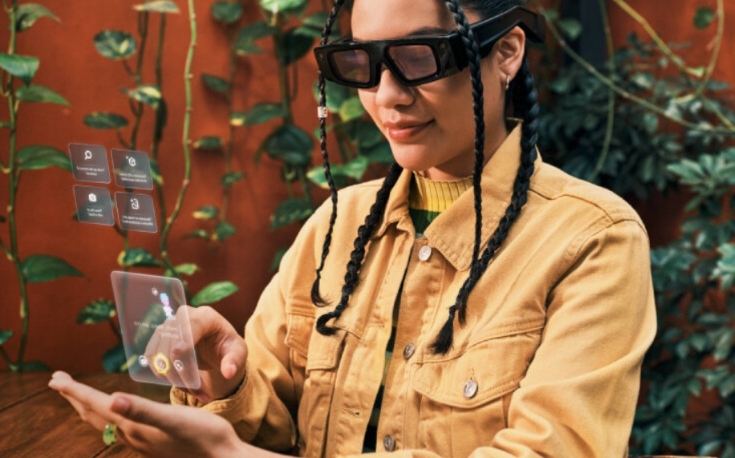
7. Easier and faster production of 3D content and environments: AI assisted tools can now turn ordinary photos, video, or even a written description into a usable 3D model or scene, where producing the same thing once took specialist 3D modelling skills and weeks of work, so a soil profile, an insect, or a piece of machinery can go from a phone photo to an explorable 3D model far faster than before. A more advanced version of this, 3D Gaussian Splatting, reconstructs a real space from overlapping photos or video into a photorealistic, walkable 3D scene in hours rather than weeks, by having AI estimate camera positions and rebuild the scene from millions of tiny coloured points rather than a hand built mesh. This is well suited to capturing a real farm or demonstration site for use as a digital twin, and to anchoring AR content more precisely onto a real object, though it still needs a capable GPU, is harder to edit afterwards than a traditional model, and produces large files that need planning for on slower rural connections.
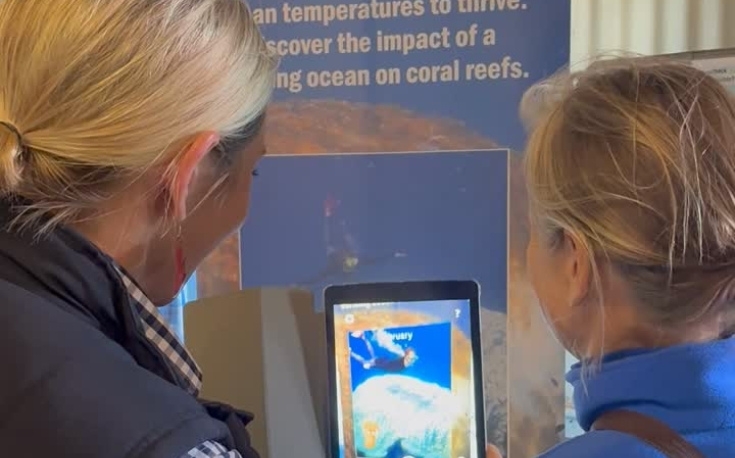
A recent example of this same AI-assisted approach, applied to environmental education rather than agriculture, comes from our work with researchers at the University of Queensland. They had a set of images of corals taken at different points in time and asked us to bring their educational banners and one-pagers to life through AR. We used AI to turn these still images into an immersive video, then added a 3D animated character on top that comes alive directly from the printed image, explaining what is happening to the coral and how human behaviour is affecting underwater ecosystems. A video of this project will be made available here by the end of July 2026.
8. More accurate spatial computing: Underneath this sits spatial computing, the sensing and mapping layer that lets a device understand a real 3D space well enough to keep a virtual object fixed to one real spot as a person moves around it, rather than drifting like a simple flat overlay. Companies such as Niantic are building large scale geospatial maps of the real world, sometimes called a visual positioning system, that let AR content be anchored persistently to specific real locations, a paddock, a building, a piece of infrastructure, rather than only floating loosely in front of a camera. This is not a separate category from AR or MR; it is the technology getting more precise underneath them, which is what makes a live data model of a real crop, machine or field, a digital twin, practical to build and maintain for an everyday extension programme rather than only for a research pilot.
As phones, connectivity, headsets, glasses and 3D capture tools keep improving together, they increasingly become something a farmer, extension agent or rural community simply has on hand, day to day.
With strong expertise in designing and developing immersive learning activities for agricultural and environmental extension and education, CreativiTek would love to help bring your idea to life, or to talk through how these technologies could be used for your purposes. Just email us at This email address is being protected from spambots. You need JavaScript enabled to view it. to collaborate, engage, educate and empower your target audience using the amazing opportunities immersive technologies open up.